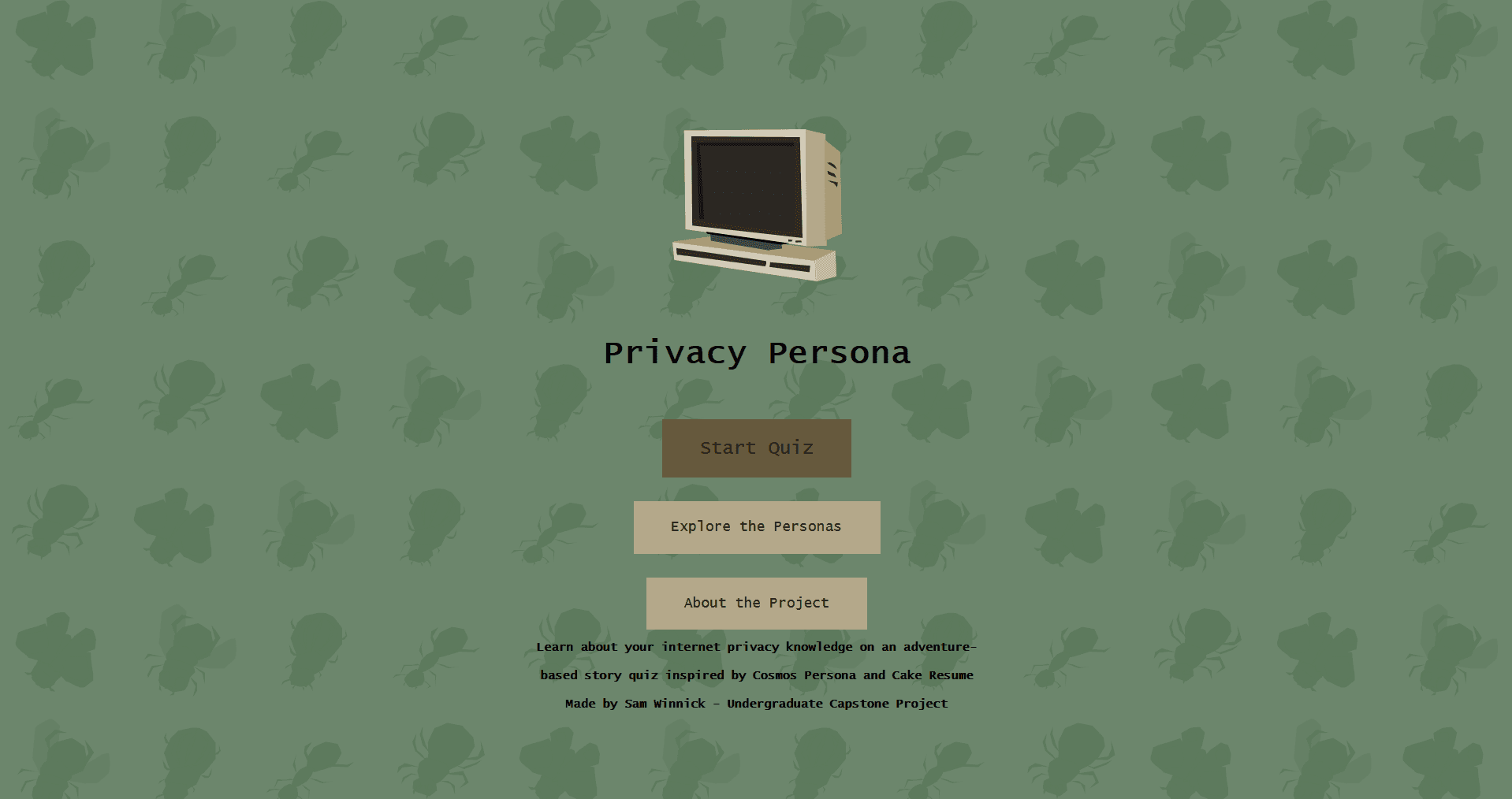
Privacy Persona was my final capstone project for my Culture and Technology Studies degree at the University of Guelph. The project has been in development since September 2025, including 3 prototypes and a research paper. I wanted the foundation of my project to be engaging in creative, playful, artistic collaboration with technology, while tackling important topic awareness in todays digital age. Privacy Persona not only functions as a means of self-reflection on one’s personal internet habits, but also the project itself is a model for the possibilities to employ the deliverability of technology and the engagement of the arts to create digital and social discourse.
Privacy Persona is a 12-question web quiz that guides the user on an adventure-based narrative story where the result categorizes a user into one of five personas: the Fly, the Ant, the Moth, the Beetle, and the Spider. The theme of the quiz, surrounding nature and exploration, acts as an allegory for the internet/world wide web. Each question was written using a foundation of research on the most common areas of internet literacy skills, the safest web habits, statistics, and using existing privacy questionnaires as a framework.
Research was completed over the course of the year in multiple areas of study, in order to ground the project in preexisting scholarship, to develop the questionnaire, and to explore the deliverable method and history of self assessment. The question used to guide the research for this project and to identify the goal was, “looking at what the existing knowledge gaps in digital literacy are, more specifically, World Wide Web (web) privacy skills, is a way to bring attention to the rising concerns of web privacy through self-assessment?”.
The process of creating this project was planned over a 3-month period with an estimated 1200 hours of work time. The first month, January, was dedicated to research, writing the questionnaire and creating the personas. In February I began coding, which would be the largest learning curve of this project. I had a small background in HTML/CSS before this project and had to learn JavaScript in order to create it myself. I also was completing the questionnaire as I began writing the code, which was helpful for iterating and having a better vision of the final project. Around February I reached out to the creator of Cosmos Persona, which was one of the main inspirations for my project, to ask for consent in using components of her code in order to write mine. They were kind enough to agree and I was able to develop a better understanding of JavaScript through her work! Around this time, I also had my brother assist me in setting up my GitHub code repository through pushing on Visual Studio code (Thank you Tanner!).
I knew going into this project I was interested in learn about ethical AI usage and wanted to explore working with ClaudeAI to debug my code. I was also taking a course with Professor Zhao at the University of Guelph in User Interface and Experience this semester, who was also my amazing project mentor! Part of the course discussed AI usage and integration into project workflows, and how to work collaboratively and effectively to ensure educational and ethical use. This project was the first time I worked with ClaudeAI and it was very interesting to see how helpful it was when it came to solving issues and providing JS functions based on my goals. At times it was difficult due to its uncertainty in its own responses, or by providing complicated solutions rather than straightforward ones, however overall I felt very happy with the way it supported my project development and how it explained algorithmic functions when it presented solutions. I wanted to ensure I was learning while using the tool rather than relying on it for writing the entire code. For example, ClaudeAI explained thoroughly the purpose and usage of a Document .getElementById function and I was able to learn and reuse this component throughout my quiz. Near the end of the project development I wanted to change the algorithm to be points-based rather than most common result. ClaudeAI was very helpful in providing an easy fix without changing the other functions.
Near March, I designed and drew the visual components of my quiz as I began focusing on styling the CSS. I created a colour palette for each persona using https://coolors.co/?home , and created the template results using Affinity by Canva. I also used Inkscape to draw the personas. I spent a lot of time iterating the visual components, ensuring button functionality, adjusting layouts, and ensuring mobile compatibility. This part of the process was the most time consuming due to pushing the code and checking the updates on web. I am curious of there could be a more efficient way of viewing changes and would be interested in exploring this for a future project.
The biggest challenge I faced when completing this project was time constraints. I think that my project was very feasible for the time period we were given to complete it, however it was difficult in terms of time management to ensure all the components were equally complete and functional. I wanted to have my project deliverable be the strongest component of my project due to the goal of shareability, however looking back I wish I had allocated more time to enhancing my research tracking and attaching those components to the project. Creating more organized documentation as part of the project would allow it to exist on the same level of completion and organization as the deliverable. I had many physical pages of notes, drawings, and sketches, as well as screenshots of the persona iterations, colour palette variations, and testing drawing software. Having more scholarship and background work attached to the front end of the work would encourage people to take further steps in educating themselves on digital literacy. This could be something to add in the future for this project and I would be interested in developing it further. One component I was not able to complete was the graphics for each question, due to time constraints. However, I also would enjoy adding this to the project in the future to enhance the game/immersive experience.
The goal of this project was not to become the most updated resource for skill development in internet privacy, but to become a source of awareness and engagement for it. The natural shareability of quiz content as discussed by Berberick and McAllister in “Online Quizzes as Viral, Consumption-Based Identities”, allows for these projects to reach many internet users and act as a means of self-promotion for the project itself, encouraging discourse and topic awareness.
I believe that this quiz will be successful and has been successful already in many ways, due to the positive feedback I have received from friends and colleagues about the excitement of engaging with quiz taking. Being able to engage with scholarship in non-traditional methods has allowed for people to become inspired and ask questions about digital literacy learning. People have found the artistic components of the project to be very valuable and an integral part of shaping the way people view the bridge between technology and art.
I learnt many skills throughout the process of this project which I feel very accomplished about having set out to do so from the start of the project planning. I have developed skills in HTML/CSS, as well as learnt basic JavaScript components. I have learnt to create code repositories on GitHub and set up push/pull commits from Visual Studio for a streamlined process. I learnt to work collaboratively with AI to create meaningful progress in project development and debugging. I also learnt new software, such as IBIS Paint (in the end I decided to not use for my project however will be exploring more in the future), Inkscape, and developed further skills in Affinity. I have also developed project management skills through organization, planning, and time allocation for workflow steps. I have also practiced my skills in UX and UI, including colour design, interactivity, accessibility for web, and device responsiveness.
I am very eager to create more projects similar to this one that engage with academic topics, critical discussion online, and creative arts. Sharing this project to a larger community online is also a goal I have, I would like to see more user feedback across a wider age range and engagement with the persona results. Adding a section to the project about tips, habits, or ways to improve on digital literacy would also be a development I am interested in working on. I would like to create a stronger sense of thoughtful skill enhancement for users who may not have as much confidence in their online privacy skills. Adding links to more resources, a list of the most common mistakes users make online, or more mindful practices may be beneficial to create more meaningful takeaways from the quiz.
Creating a project from start to finish was an incredibly rewarding learning experience, I am very grateful to have had this opportunity to bring an idea to life while being a student. I thoroughly enjoyed receiving feedback from others about my project and engaging with my classmates projects as well. I learnt a lot about failure and making mistakes over the course, from seemingly unfixable coding issues or finding a relevant scholarly source halfway through the semester. I feel that the drive I have developed to continue working through the project despite moments of doubt or uncertainty due to time constraints or lack of components will be useful to have for the future.
There are many mixed feelings I have about completing this project, as much as I am very excited to have finished it I am also saddened by the completion of my undergraduate degree and time in the Culture and Technology Studies program at UoG. Thank you to my professor Susan Brown for all of her support and feedback throughout the course! I feel very accomplished and can acknowledge the gaps in the final product in terms of transparency of research and documentation, however, the goal of my project existing as a standalone creative and technological collaboration I believe has been successful. I am very proud that the project has come together so neatly and closely to what only started as ideas from the Fall, and I am very excited to have it be a part of my portfolio.